
“Would you be interested in interpreting an event?”
Mr. Cho’s message caught me off guard. I had never interpreted in my life, just a few informal favors, nothing more. Interpretation is its own art form, and I was no professional.
Still, curiosity got the better of me.
“What is it about?”
“It’s about Haenyeo. It’s the 10th anniversary of Haenyeo being registered at UNESCO as Intangible Cultural Heritage of Humanity.”
Haenyeo are the women divers of Jeju Island, who free dive to the ocean floor to harvest abalone, conch, and seaweed, with no oxygen tank, often well into their seventies.
I made up my mind the moment I read the word Haenyeo. I told him, shyly, that I wasn’t fully confident. Was that okay?
He reassured me that I could do it. Korean to French, in front of a crowd at IUCN.
I felt the adrenaline rush, something I hadn’t realized I missed.
Learning What I Thought I Already Knew
I said yes not just to interpret, but to finally understand. Until then, I had known about the Haenyeo the way most people know about things from another generation: through documentaries, through fragments, through the soft lens that media likes to use. I knew the shape of them, but not the weight.
So I read. I read about why these women dove the way they did, and why, against every assumption people make about gender roles in old Korea, it was a profession dominated by women — not exclusively, but overwhelmingly. I began to understand why their way of life had been deemed singular enough, fragile enough, worth protecting enough to earn a place on UNESCO’s list.
And somewhere in that reading, I started recognizing my own blood.
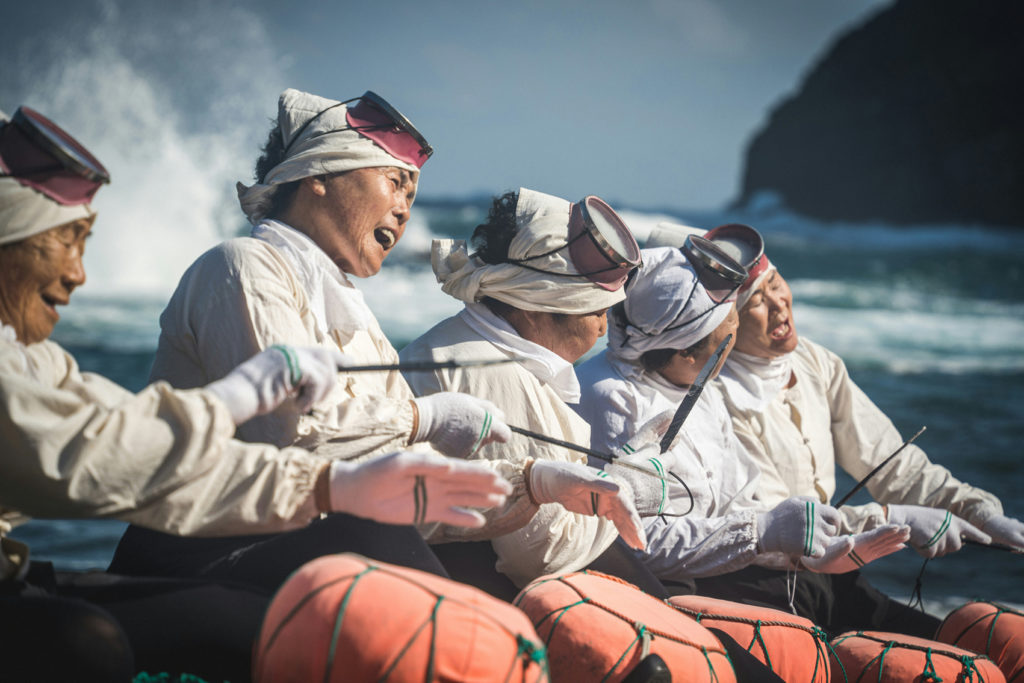
Photo: John Ko / Unsplash
They Were Never a K-Drama
Here is the thing I had to unlearn first: the Haenyeo are not romantic.
K-dramas have a way of taking something hard and varnishing it until it gleams, until the sea looks like a backdrop instead of a danger, until the women look like muses instead of providers. But the Haenyeo were not chasing a poetic life underwater. They were doing what necessity demanded. They took the risk because someone had to feed the family, and the sea was what they had.
These women grabbed their lives by the horns. There was no soft entry into it, no choice dressed up as destiny. Every dive was a small negotiation with danger. No oxygen tank. Just breath, training, and decades of knowing exactly how long a body can hold on before it must surface.
And the cruelest irony? Many of these same women, when their own daughters said I want to be a Haenyeo too, said no. Out of fear. They knew the cost in their bodies. They didn’t want their daughters to pay it.
Grandmother, Mother, Daughter
The event I came to interpret wasn’t about the Haenyeo as a general heritage. It was about lineage. It was organized by a professor and photographer who had spent his time capturing something specific: the Haenyeo who dive in the same families.
Three generations, sometimes more. Grandmother to mother, mother to daughter, sometimes extending sideways into sisters-in-law, or stretching across decades of childhood friendship. Women who once refused their daughters, and then watched them choose the sea anyway. Now you can see them diving side by side, proudly, generations deep in the same water their family has always known.
That, I learned, is the real reason UNESCO didn’t just preserve a technique. The way the Haenyeo dive, unaided, breath-held, for minutes at a time, is remarkable on its own. But what makes it culture, what makes it worth safeguarding for the world, is what happens around the diving: the watching out for one another beneath the surface, the calling across the water, the shared risk that turns competitors into kin, and a quiet rule passed down with the diving itself: never take more than the sea can give back. Muljil was never a solitary act. It was always communal, always women holding the line for the women beside them.
Two Women in the Crowd
Two Haenyeo were present at the event that morning, one in her twenties or thirties, the other in her fifties or sixties. At a glance, they looked like any other women their age. But there was a je ne sais quoi in their eyes, something twinkling, that I couldn’t quite place.
If I had passed them on the street, I would never have guessed who they were. That made the truth of what they do even harder to hold in my head: that these same hands, these same eyes, go under the water and stay there with nothing but breath and instinct.
I spoke with the older one after the event. Before we said goodbye, I made her a small promise: that one day, when I’m in Jeju, I’ll come find her restaurant and visit.
I meant it. I still do.

Photo by Ji Seongkwang / Unsplash
Full Circle
Standing in front of that crowd, translating Korean into French, carrying someone else’s words about the Haenyeo across a language I didn’t grow up speaking at home, I understood something I hadn’t expected to find in that assignment.
I had said yes because I missed the adrenaline. I stayed in it because I needed to come home to something I’d only ever loved from a distance. The Haenyeo gave me that: not just a story about brave women in the sea, but a glimpse of the toughness running through where I come from. Women who didn’t choose ease, who carried their families on their backs, who still found each other in the water, generation after generation. And that same morning, two of them stood right in front of me, ordinary at first glance, proof that it was all real.
I am not a Haenyeo, and I’ll probably never dive the way they do. But for one morning, standing between two languages, I felt closer to being Korean than I had in years. Not because of where I was born, but because I caught a glimpse of what it costs, and what it gives, to be a daughter of that sea. And somewhere in Jeju, there’s a small restaurant I still intend to find.


Beautiful experience and reflection. Feeling culture flow trough us in our native tongue is something truly wonderful.
Thank you for reading and for your comment, Lúcás. I’m glad that came through. 🌊
How wonderful to truly reconnect with our roots, with ourselves ! Thanks for sharing this wonderful experience dear Yona!